Archive

Posts Tagged ‘overheating bus plug’

Bus Plug Blog – Overheating Bus Plug with too Many Feeders
August 10th, 2011 Comments off


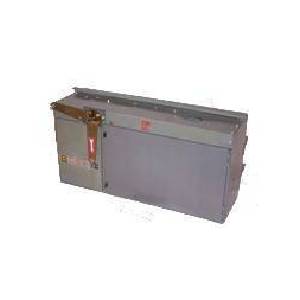
PBQ3640G Square D Bus Plug - Buy at www.swgr.com

PBQ3640G Square D Bus Plug – Available at www.swgr.com

During a routine Infrared Scan of a large manufacturing facility, our Thermographer found an interesting, but not uncommon, problem. A 400 amp Square D bus plug, PBQ3640G, was lit up like a dim light bulb. That means the entire bus plug looked warm, not just one area of the bus plug. Note, when viewed with infrared, it does not take much of a temperature difference for an object to look dramatically warmer than the area around it. But this was hot enough to indicate there was a problem, an overheating problem that was not localized inside the bus plug. While trying to angle for another view of the bus plug, our Thermographer discovered three different feeder conduits coming out of the 400 amp bus plug. One went to a 400 amp panel board, one went to a 225 amp lighting panel, and one went to a molding machine.  As it turned out, there was a lot of load diversity, but the electric heaters on the molding machine were just too much. There was not a problem yet. There were no poor connections causing the heat. But the total load on the 400 amp bus plug was high enough to make the entire bus plug look warm under Infrared. If they continued to add load to the panel board or to the lighting panel, the fuses in the bus plug would have blown. Ignoring the fact not all the individual feeders out of the bus plug were protected, sooner or later they were going to have a problem with the PBQ3640G bus plug. Their solution was to put the molding machine on a new separate bus plug.


Bus Plug Connection or Load Problem Using Infrared

November 24th, 2010 Comments off

MIDWEST frequently is asked how we can tell if an overheating problem in an electrical bus plug, found using Infrared Thermography, is a connection problem or a load problem. Especially when the bus plug cover can not safely be opened.  Overheating from a load problem usually displays a paintbrush effect on the bus plug enclosure. Large and continuous areas may display a higher temperature pattern. Looking at the electrical bus plug from different angles may still display a wide pattern of overheating and no indication of a spot source. This is difficult, even for an experienced Thermographer. MIDWEST’s Thermographers have the advantage of extensive training and experience reconditioning, maintaining, repairing and testing bus plugs in our switchgear shop. With this experience, they know the location of the internal components of the various bus plugs, whether Square D, Cutler Hammer, GE General Electric, Westinghouse, ITE Bulldog, or Federal Pacific. The combination of this knowledge and experience and their understanding of Infrared Thermography, gives them the tools they need to best differentiate between overheating due to load and overheating due to a poor connection or contact.


A connection problem may display a more localized heat pattern that sometimes can be confirmed by Infrared Scanning the bus plug from different angles.  The heat pattern at each angle may confirm the heat is coming from the same somewhat specific location.  With the cover closed, it is very difficult to identify the exact location. It might be the fuse clip or the lug for a feeder cable or the switch or breaker contact.


Finally, when possible, measuring the load on the bus plug feeder, when safe, and comparing it to the bus plug rating can help validate whether the problem is load or connection. Only when safe, the bus plug cover may be opened and an accurate scan of the inside of the bus plug performed.  It is not always possible to determine the exact cause of overheating in a bus plug, but these are some of the tools that increase our success.