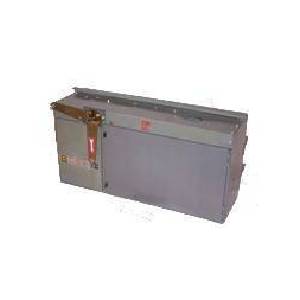
PBQ3640G Square D Bus Plug – Available at www.swgr.com
During a routine Infrared Scan of a large manufacturing facility, our Thermographer found an interesting, but not uncommon, problem. A 400 amp Square D bus plug, PBQ3640G, was lit up like a dim light bulb. That means the entire bus plug looked warm, not just one area of the bus plug. Note, when viewed with infrared, it does not take much of a temperature difference for an object to look dramatically warmer than the area around it. But this was hot enough to indicate there was a problem, an overheating problem that was not localized inside the bus plug. While trying to angle for another view of the bus plug, our Thermographer discovered three different feeder conduits coming out of the 400 amp bus plug. One went to a 400 amp panel board, one went to a 225 amp lighting panel, and one went to a molding machine. As it turned out, there was a lot of load diversity, but the electric heaters on the molding machine were just too much. There was not a problem yet. There were no poor connections causing the heat. But the total load on the 400 amp bus plug was high enough to make the entire bus plug look warm under Infrared. If they continued to add load to the panel board or to the lighting panel, the fuses in the bus plug would have blown. Ignoring the fact not all the individual feeders out of the bus plug were protected, sooner or later they were going to have a problem with the PBQ3640G bus plug. Their solution was to put the molding machine on a new separate bus plug.
During an Infrared Scan, or Thermographic Scan, of the electrical distribution system of a new account, MIDWEST’s Thermographer noted in his report a strange bus plug set up. A 200 amp Cutler Hammer bus plug had a 2 inch pipe installed right in front of the cover. The pipe was 3 inches from the bus plug cover and right near the operating mechanism. The pipe was just kind of hanging there. It didn’t have much support. It went to a huge molding machine near the Square D bus duct. So you couldn’t switch this 200 amp Square D bus plug from the floor and you couldn’t open the cover of the bus plug, if you had to, because of the pipe. Who in their right mind would do this? As it turns out, they had an emergency and had to get a temporary line to the molding machine as fast as possible. Apparently the line carried plastic used in the molding machine and this machine was their main money maker. So they just installed pipe temporarily as quickly as possible. And six years later, the temporary pipe was still there. It more or less had become permanent. Temporary installations evolving into permanent, is not an unusual occurrence. In the real world, production rules. And like it or not, the same rules that caused a temporary pipe installation, also prevent the permanent installation. In the electrical equipment world, this is somewhat self correcting when the equipment gets unhappy with a bang. Bus plugs do fail if they are ignored too long. Whether a GE General Electric, Square D or Cutler Hammer bus plug, it will eventually fail if ignored long enough. When these things happen, those temporary fixes come back to bite you.
Categories: General Bus Plug Information Tags: 200 Amp Bus Plug, 200 Amp Cutler Hammer Bus Plug, 400 Amp Bus Plug, bus plug, Electrical Distribution System, GE, General Electric Bus Plug, Infrared Scan, Square D Bus Duct, Square D Bus Plug, Thermographic Scan
MIDWEST was asked why the total capacity of all the bus plugs connected to a 1600 amp bus duct was over 2500 amps. The particular facility had one 400 amp bus plug, four 200 amp, eight 100 amp, and twelve 30 to 60 amp bus plugs on the old bus duct. These were mostly very old bus plugs and a few reconditioned or new bus plugs. Purchasing wanted to order two new 60 amp bus plugs but didn’t know how it was possible to have over 2500 amps connected to only a 1600 amp bus duct and then add more. Actually the equipment he wanted was no longer manufactured, so he would have to use old reconditioned or refurbished bus plugs. It was a maintenance man asking purchasing the question. This was a case were the maintenance man was doing production equipment repair one day and electrical maintenance the next. But he was not an electrician by trade. MIDWEST explained. The size of the bus plugs is nominal. The actual fuse or breaker in the bus plug may have a lower rating. For example, a 100 amp bus plug may have a 60 amp fuse. Or 250 amp fuses in a 400 amp bus plug. In addition, all connected load is not on all at the same time. There is a diversity factor. The diversity of an old or new bus duct system might result in only 50% loading. It would not be unusual for a 2000 amp bus duct to have less than 1200 amps on it. We get extremely nervous if the load approaches 80%. We see a huge increase in problems when this equipment is operating anywhere near full rating. When we infrared scan a bus duct that is heavily loaded, the whole bus duct and many of the bus plugs just seem to light up under infrared. So usually old and new bus plugs and bus ducts are not loaded to full rating, but when they are, bad things start to happen. If the load is not known, it may be easy to spot measure the load on the bus plug feeders. Do this safely at the load. Do not measure load at the bus plugs. That would be extremely dangerous. Always, safety first.