Archive

Posts Tagged ‘bus ducts’

Crazy Arc Blasted Bus Plug

July 25th, 2012 1 comment

MIDWEST was in a manufacturing facility collecting data for an Arc Flash Hazard Analysis project.  While reviewing one of two main 1600 amp bus ducts through the facility, we came across something our Engineering Technicians thought was pretty crazy.  Crazy, but interesting.  One of the bus ducts had a bus plug with black soot on the side from an apparent internal fault.  It was an ITE BOS14353 bus plug and the soot had been blasted out of the seams of the cover and conduit box connectors and between the bus plug and bus duct.  The cover didn’t look like it was bent, but there was a lot of black stuff on the sides of the ITE bus plug.  We asked the maintenance man if he saw that and he said “Oh, ya,” they had a fault at the bus plug, but it didn’t trip the main breaker for the bus duct so they refed the machine from a different bus plug.  They couldn’t turn off half of production for one machine.  They didn’t touch the blasted bus plug, which was wise since they wouldn’t turn off the bus duct.  The feeder from the bus plug fed a fused disconnect mounted separately from the machine.  So they just turned off the disconnect switch, attached the LOTO, and refed the machine from a different BOS14353 bus plug to a new separate fused disconnect.  MIDWEST reconditions ITE BOS14353, General Electric FVK363, Square D PFA36100, ITE UV363, or Westinghouse ITAP363 bus plugs every day.  We know from shop experience and field service experience that the blasted bus plug was a ticking time bomb.  Sooner or later, it was just a matter of time, there was going to be another fault at that bus plug.  Probably at the connection to the bus duct.  Sooner could be an hour and later could be a couple years.  But the big concern was not for the bus plug, it was for a fault in the bus duct itself.  The black soot gets everywhere and the bus duct is very vulnerable.  If it faults, half their plant could be down for possibly days.  By shifting the attention from the bus plug to the bus duct, maintenance got an outage within days to remove the bus plug and clean up the bus duct.  A wise and safe decision.
Bus Plug Eureka Moment

August 25th, 2010 Comments off
 
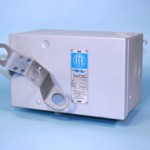
XLVB321 ITE Bus Plug

XLVB321 ITE Bus Plug

Having spent forty years of an Electrical Engineering career in Industrial Research and Development, I feel extremely comfortable in an Electrical Engineering Power Laboratory.  There were few pieces of electrical test equipment that I did not know intimately and use on a regular basis.  Working with 240 and 480 Volt, three phase equipment was quite normal.  And in a Research and Development laboratory, the power wiring was always in a state of flux.  Wiring could be changed minute to minute, hour to hour.  Virtually all power connections were considered transient. 

 So, it came as a surprise when someone used the term “bus plug” to me.  At first, it sounded like somebody from the transit company had an all electric powered school bus, and they had to find a suitable wall outlet to plug into.  Close, but no cigar?   Actually, this wasn’t even close.


Embarrassingly, I had to ask what a bus plug was.   Well, the guru from MIDWEST asked me where did I get my power?  Well, I said, there usually was a distribution network of rectangular gray metal conduits that contained the three phase power busbars that spidered to every lab bench.  I knew these were called bus ducts.  Then the guru asked how did I connect to it?  Well, I said, there are these boxes that attach to the bus ducts.  Each bench’s power comes from these boxes.  Inside, there are usually fuses, and a switch.  The switch usually was just a metal arm with a hole in it that came out of the box.  To turn them on and off, we had long poles with a hook on the end that captured the hole in the arm.  I used these all the time.  Most of the lab benches had these long poles right next to them.  But, the only time I ever saw the interior was when a fuse had been blown inside the box; even then, it was usually a technician’s job to climb up a twelve foot ladder and replace the fuse.  But, a few times, usually at 3 am, I was the one that climbed the ladder.


And the MIDWEST guru said, those boxes are called bus plugs.  Eureka!!!  I’d been using them forever, and just didn’t know what they are named.  It was explained that in order to tap the power from the bus duct conductors, spring loaded fingers touch the internal conductors.  It was also explained that these bus plugs could more or less be snapped onto the bus ducts most anywhere.  


And I said, “Well, now I know exactly what a bus plug is.“