Archive

Archive for June, 2009

Strange Fusing Inside Bus Plugs

June 26th, 2009 Comments off

We are a maintenance and engineering service company and sometimes we find some rather strange things when we peek on the inside of a bus plug during an outage or Infared scan.  There are the times a three phase, 100 amp bus plug is fitted with two, 80 amp fuses and one 90 or 95 amp fuse.


This begs the question did the other 80 amp fuse blow and all that was lying around was a 95 amp fuse or was the bus plug moved to that location recently from somewhere else and really there should have been  three, 60 amp fuses in it?   Bus plugs come in many voltage and ampere ratings the common ones are 30 amp, 60 amp, 100 amp, 200 amp, 400 amp, 600 amp and even the monster 800 amp bus plugs.  These amp ratings sizes relate to the amp rating of the live parts.  Fuses come in all physical sizes, voltage ratings and ampere ratings.  Just because a fuse will fit in a fuse holder does not necessarily mean it is correct to use.  It is important to ensure that the voltage rating of the fuse meets or exceeds the voltage rating of the bus plug.  A 600 Volt or 480 Volt fuse in a 480 Volt bus plug is OK.  A set of 240 Volt fuses in a 480 Volt bus plug is not OK.  The next consideration is the amperage of the bus plug.  The live parts, the fuseholder and switch, are sized for the amp rating of the plug.  You can always put in smaller fuses, ideally three of the same size, but don’t exceed the rating of the bus plug and install higher amperage ones.  The fuses may just sit there and the poor fuseholder or switch can become the fused element instead.   Reusing your available bus plugs is acceptable if you pay attention to the voltage and current ratings. 
 

Maintenance of Your Bus Duct Distribution System

June 16th, 2009 4 comments
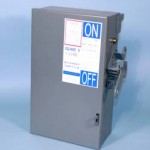
Square D Bus Plug

Square D Bus Plug

It is always a good idea to de-energize bus duct before you install or remove a bus plug.  If the plug is heavy it can be difficult to engage or disengage across all three phases at the same time.  The result is you could partially engage one or more of the phases and twist or bend the connection point.  This could result in subsequent hot spots which could lead to failure. 

You also have to consider that this failure would occur on the line side of the bus plug where the current and hazards are much greater rather than the load side, where the amperage would be much lower.  Want easy proof?  Consider 200 amp bus duct with ten, 30 amp bus plugs (each fused at 20 amps).  The problem on the line side of any one of the ten, 30 amp bus plugs is really a problem on a 200 amp piece of equipment.  The same goes for removing a plug with the bus hot.  The plug may be dirty or greasy and harder to control as you try to close it in or withdraw it from energized bus.  Better to move the plug with the bus turned off.

Reconditioned Bus Plugs

June 2nd, 2009 Comments off

Bus plugs that are reclaimed from actual industrial sites usually have many years of accumulated dirt and grime.  We frequently find them painted over to match a ceiling or wall or to indicate that this plug was from the (fill in your color) circuit.  When we find a really clean one from a spotless facility or one that looks like it saw little active service we still take them apart and recondition them on the inside.  Our reconditioned units carry a one year warranty so we have to know we have completely gone through them.  We would hate to take a chance on a shiny one without any scratches on the outside and sell it as-is.  The fine exterior could hide the fact that the fuse holders or other live parts, inside, sustained overheating or mechanical damage.  Then we are forced to take the damaged unit back under warranty.  The only time a piece of inventory leaves our shop in the ‘raw’ condition is if it is being purchased or traded to another company where we know the unit will be reconditioned by them before they sell it.